


PORTFOLIO
THEATER DIRECTING

IN THE GREEN
by grace mclean
directed by Anna Miles at The Wayward Artist, 2023
In the Green
In the Green is an experimental, music-driven retelling of the early life of Hildegard von Bingen, tracing her formative years in isolation before she emerged as a visionary healer, composer, and spiritual leader. The piece channels the subconscious and interrogates repression, desire, trauma, and the tension between sanctity and selfhood through a visceral blend of music, movement, and ritual.
My direction centered on making the internal narrative tangible and visible: a central onstage sand pit served as both a tactile design element and a living metaphor, reflecting the characters’ buried histories and suppressed secrets. Shadow puppetry and silhouette work externalized the “shadow self,” to depict the characters confronting their subconscious trauma. The space began entirely swathed in white fabric to evoke both sanctity and suffocation, which was gradually stripped away to reveal greenery breaking through the floor, to represent that growth and memory persist despite attempted suppression.
I incorporated immersive and participatory elements to extend the world beyond the stage and further expand the communal ritual between audience and story: a live sound looper improvised an evolving sonic landscape as audiences entered, and an interactive altar invited them to bury their own secrets in sand before the performance began. Supported by an all women/nonbinary cast and crew, the production integrated unique fiber art design elements and costume work, movement, and live looping to create a sensory environment that was raw, intimate, and ever-shifting, with each performance offering a distinct new experience.
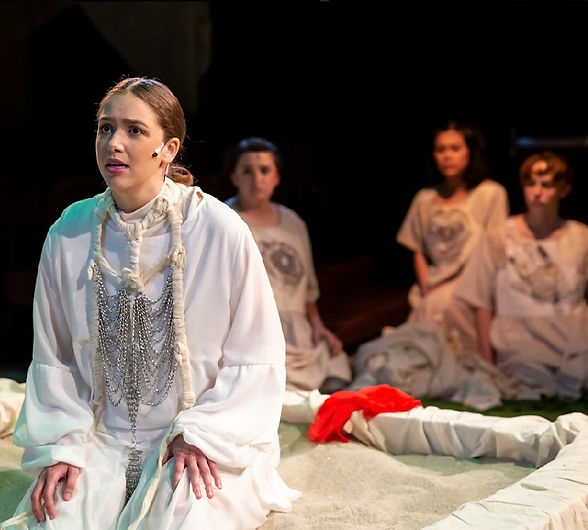


production photos by Francis Gacad

2020-2023
THE TAMING
by lauren gunderson
directed by Anna Miles at Little Fish Theatre, 2026

The Taming
The Taming is a sharp, fast-paced political comedy that throws three wildly different women into a hotel room on the eve of a beauty pageant and launches them into a political, personal, and constitutional crisis, exploring contemporary American politics, ideological divides, media spectacle, and the messy contradictions of identity, ambition, and belief.
My direction approached the play as a “political fever dream,” emphasizing the exploration of the tension between performed identity and genuine conviction. I leaned into the script’s inherent theatricality, heightening both its overt spectacles (pageantry, social media performance, political mythmaking) and its more insidious performances of gender, virtue, and belief.
This fever dream world was driven by an aggressive, immersive sound design and transitions staged as disorienting, high-energy liminal interludes where time collapsed and spectacle overtook logic.
Overall, the production aimed to replicate the sensory overload of modern political discourse and the constant noise of contemporary media by inviting the audience to experience that chaos while simultaneously watching as these women fought their way through it toward clarity, connection, and meaningful dialogue…all while remaining fast, irreverent, hilarious, and unapologetically fun.


production photos by Eric Modyman
INTO THE WOODS
by stephen sondheim and james lapine
directed by Anna Miles at The Woodland Opera House, 2025
Into the Woods
Into the Woods intertwines beloved fairytale figures to create a richly layered and morally complex musical fable about desire, consequence, and responsibility.
My direction centered on “the woods” as a living, sentient force that observed, responded, and reckoned with the human characters’ individualistic behavior. I introduced a spectral ensemble of forest spirits who functioned as both environment and witness, embodying the natural world and amplifying the idea that every action leaves a trace.
Transformation and collapse were the primary visual and dramaturgical engines of the production: Act I embraced a heightened, storybook aesthetic, grounding the audience in familiarity and enchantment. As the narrative progressed into Act II, that illusion unraveled: the world deteriorated into a meta-theatrical wasteland where backstage mechanics became visible, work lights replaced theatrical polish, and the artifice of storytelling could no longer be hidden. To further interrogate control and authorship, the Narrator was framed as a manipulator of events through a miniature marionette theater that was an exact replica of the stage, suggesting both the illusion of control and its inevitable failure.
Across all elements, the production emphasized the tension between agency and consequence, ultimately framing the woods not just as a place of magic, but as a space where stories - and those who tell them - are held accountable.


production photos by Zoart Photography

A SAD TALE'S BEST FOR WINTER
by anna miles
written and directed by Anna Miles for Noise Now at A Noise Within Theatre, in Partnership with Beating of Wings Collective, 2019

A Sad Tale's Best for Winter
A Sad Tale’s Best for Winter is a feminist adaptation of The Winter’s Tale that interrogates Shakespeare’s text to explore whether healing is possible in the aftermath of irreversible violence.
Developed in partnership with Beating of Wings and A Noise Within’s Noise Now initiative, the project challenges the authority of and reverence for the classical canon and its dominance in theatrical spaces by blending Shakespearean text with contemporary language, music, movement, and poetry, disrupting the original narrative to imagine a new mythos shaped by those historically silenced within the source material.
Thematically, the play wrestles not only with violence and healing, but with ideological extremity, asking whether it is possible to move beyond binary thinking to imagine new, more equitable ways of living and relating. It bridges classical theater and contemporary social critique, offering a space for new voices, new stories, and encouraging a more inclusive vision of theatrical storytelling.
Following a strongly received initial workshop, the project remains in active development, with plans to expand its musical and movement vocabulary and continue its production life for future audiences.


production photos by Max Herzfeldt and Miranda Clement
OUR TOWN
by thornton wilder
directed by Anna Miles at The Woodland Opera House, 2022
Our Town
My production of Our Town reimagined Wilder’s classic for a contemporary audience: still set in an anachronistic, expressive version of the 1900s, my interpretation refreshed the piece while still honoring the play’s traditional break from realism and Wilder’s goal to challenge the theatrical conventions of his time.
My direction confronted the fact that the traditional staging of Our Town has itself become an unchallenging theatrical convention; returning to the text and resisting production expectations, I
interrogated the play’s legacy of being regarded as “universal” storytelling and approached the piece as an opportunity to question whose stories are preserved as universal, and why.
Stepping away from ladders and a blank stage, our set was composed of disparate, collaged furniture pieces, a visual representation of the material accumulation of a human life and the meaning (and memories) we attach to objects. In Act III, this world was stripped away to a bare stage, underscoring the play’s confrontation with death and the ultimate loss of material meaning.
Live music was central to the production’s language, creating a visceral, communal experience that emphasized the rhythms of daily life and collective memory. Working with a diverse ensemble, the production reframed the nostalgia embedded in the text, positioning Grover’s Corners as a constructed memory that invites both reflection and critique, asking audiences not just to look back, but to consider what it means to move forward.


production photos by Zoart Photography
PUFFS
by Matt Cox
directed by Anna Miles at The Woodland Opera House, 2024

Puffs
Puffs is a comedic reimagining of a certain *familiar wizarding world,* that shifts the focus away from the “chosen one” to the overlooked students who were…also there. Following the underdog “Puff” house over seven chaotic school years, the play celebrates those who are not destined to save the world…and asks what it means to matter anyway.
My direction centered on redefining legacy and value beyond heroism. I approached the piece as an exploration of small, human impact: the idea that while we may not change the world at large, we can profoundly transform the lives around us. The production emphasized that meaning is not tied to destiny, but to connection, resilience, and the stories we choose to tell about ourselves.
This ethos was embedded in the design, which embraced a deliberately handmade, arts-and-crafts, 90s toddler-core aesthetic. The world felt constructed by the Puffs themselves (resourceful, scrappy, DIY crafty, a little messy, and full of heart), visually demonstrating them actively authoring their own narrative rather than merely existing in someone else’s.
Balancing irreverent comedy with genuine emotional stakes, the production framed Puffs as both a parody and a deeply sincere coming-of-age story reminding us that even the smallest, most unexpected lives can leave a lasting mark.


production photos by Zoart Photography
DADDY LONG LEGS
by paul gordan
and james lapine
directed by Anna Miles, Independently produced by Melissa Dunham, 2017
Daddy Long Legs:
The Musical
Daddy Long Legs is an intimate two-person musical following a young writer and her anonymous benefactor as their relationship unfolds through years of letter writing, evolving from mentorship into unexpected love. Rooted in language, imagination, and intellectual awakening, the piece explores how connections can be built and transformed through writing, literature, and storytelling.
My direction centered on making the characters’ language and writing based connection tactile and tangible. Using paper as the primary visual motif, the entire world of the play - including set, props, and other design elements - was literally constructed from paper, physically manifesting the characters’ correspondence and the act of writing itself. Letters became architecture; language became environment. As the relationship deepened, the paper world reflected both the expansiveness and fragility of connection built through words.
Leaning into the musical’s folk-inspired intimacy, the production embraced simplicity and theatrical invention, allowing transformation to emerge from minimal means. The result was a poetic, tactile staging that foregrounded the power of storytelling, education, and imagination to shape both identity and love.


production photos by Regan Wong
IT WAS THE NIGHTINGALE
by anna miles
directed by Anna Miles at Northwestern University, 2016
*honors thesis project under the mentorship of Lookingglass Theatre's David Catlin

It Was the Nightingale:
Persephone's Play
It Was the Nightingale: Persephone’s Play is a feminist retelling of the Hades and Persephone myth, reframing a narrative rooted in abduction and grief into one of agency, desire, and adolescent sexual awakening. Staged in an abandoned observatory atop a seminary school, this immersive, site-specific production transported audiences into a liminal, dreamlike environment where innocence and power collided.
Both the text and direction trace the myth’s persistence across contemporary media aimed at young women, drawing from works like Twilight, Beauty and the Beast, Peter Pan, and Wuthering Heights to reveal its function as an enduring allegory for female adolescence. The script fused original writing with found text, layering these influences to expose how narratives of desire, danger, and transformation are repeatedly encoded into cultural storytelling for girls.
Visually, the production embraced a hyper-feminine aesthetic, constructing an immersive environment reminiscent of a young girl’s bedroom. This space became both sanctuary and site of transformation, inviting audiences to move through and experience the shifting boundaries between girlhood, sexuality, and self-definition. Developed under the mentorship of David Catlin, the piece foregrounded theatrical intimacy, movement, heightened text, and sensory immersion to reimagine a familiar myth through a contemporary feminist lens.


